Homes in Del Mar Village and Del Mar Heights often feature older wood framing and plaster that trap moisture from the Pacific, especially where crawl spaces sit close to sandy soil. The mild year-round climate keeps relative humidity elevated even when air temperatures stay moderate, allowing mold to establish behind baseboards or in attic insulation after minor roof leaks or bathroom exhaust failures. Technicians must map moisture with meters rather than relying on visible stains because salt air accelerates hidden growth along north-facing walls near Powerhouse Park.
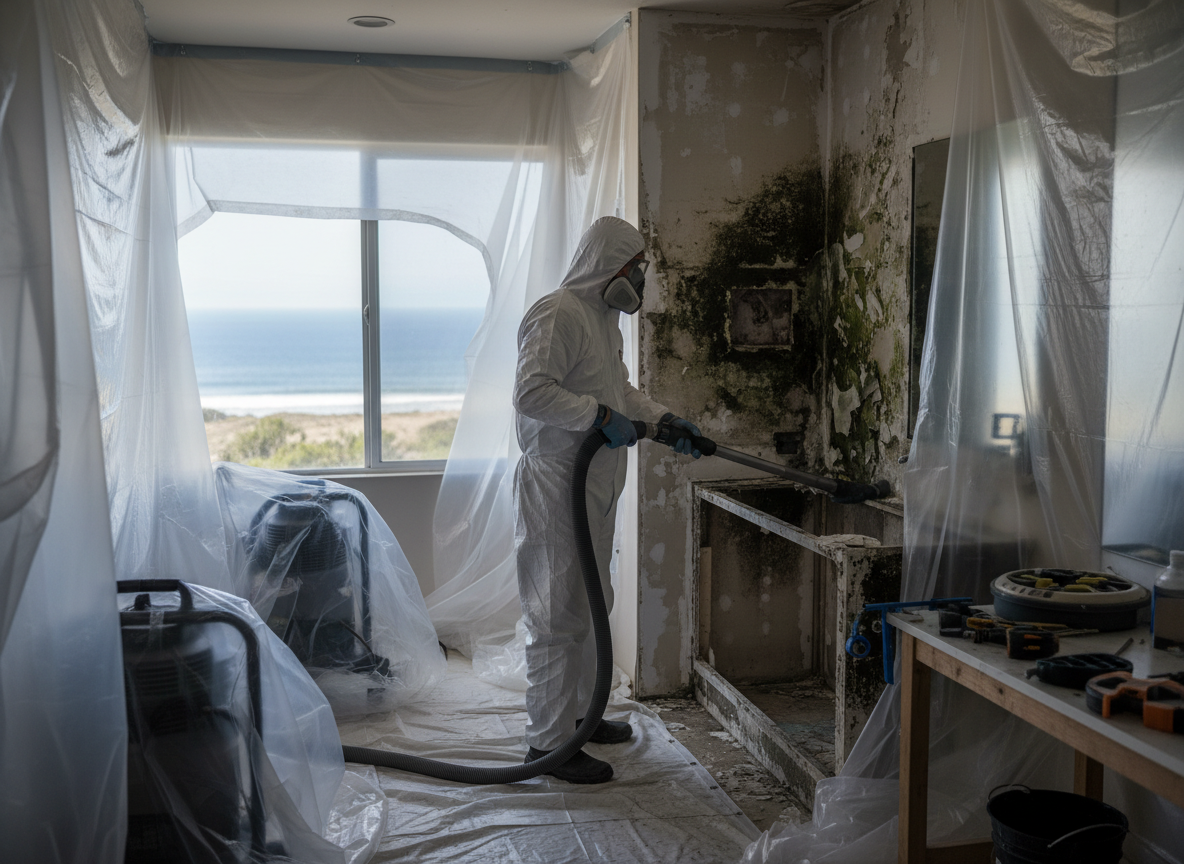
Properties closer to Del Mar Beach and North Beach experience salt-laden fog that penetrates stucco cracks, creating persistent damp zones in garages and under stairwells. Remediation here requires removing affected drywall sections while protecting HVAC returns that can spread spores into living spaces shared with neighboring Encinitas and Solana Beach homes. Containment barriers and negative air machines become essential when work occurs near the Del Mar Racetrack during peak event weeks when vibration can loosen settled spores.
San Diego County building practices in these neighborhoods frequently include slab-on-grade construction with limited vapor barriers, so slab-edge moisture migrates upward during rare heavy winter rains. Remediation teams test for hidden moisture under flooring before any demolition and use antimicrobial rinses rated for coastal exposure rather than standard solutions that fail against salt residue. Homeowners in Del Mar Heights report recurring issues when irrigation near foundations raises soil moisture levels year-round.
Technician insight
In Del Mar, the thing that catches most people out with mold remediation near me is assuming the mild Mediterranean climate prevents problems; salt air and constant coastal humidity keep crawl spaces and wall cavities damp year-round, especially in Del Mar Village homes built before modern vapor barriers, so visible surface cleaning alone never solves the source.
Hidden Growth Behind Shower in Del Mar Heights
A homeowner noticed musty odor after a slow shower leak. Inspection found moisture trapped behind tile in a 1970s Del Mar Heights bathroom that had wicked into the adjacent bedroom wall. We removed the compromised drywall and insulation, treated the framing, and ran drying equipment for three days until meters read dry. Clearance testing passed and the space was ready for new finishes without further odor complaints.
How it works
- 1
Initial Assessment
Technician arrives within hours, uses moisture meters and thermal imaging to locate hidden growth in Del Mar homes without disturbing finishes.
- 2
Containment Setup
Plastic barriers and negative air filtration isolate the work zone to prevent spore migration into unaffected rooms or HVAC systems.
- 3
Removal and Cleaning
Affected materials are removed, surfaces are treated, and air scrubbing runs until clearance testing confirms safe spore levels.
- 4
Drying and Verification
Dehumidifiers and air movers dry the structure, followed by post-remediation sampling before any reconstruction begins.
Pricing
Cost depends on square footage affected, material types, and access difficulty in older coastal homes.