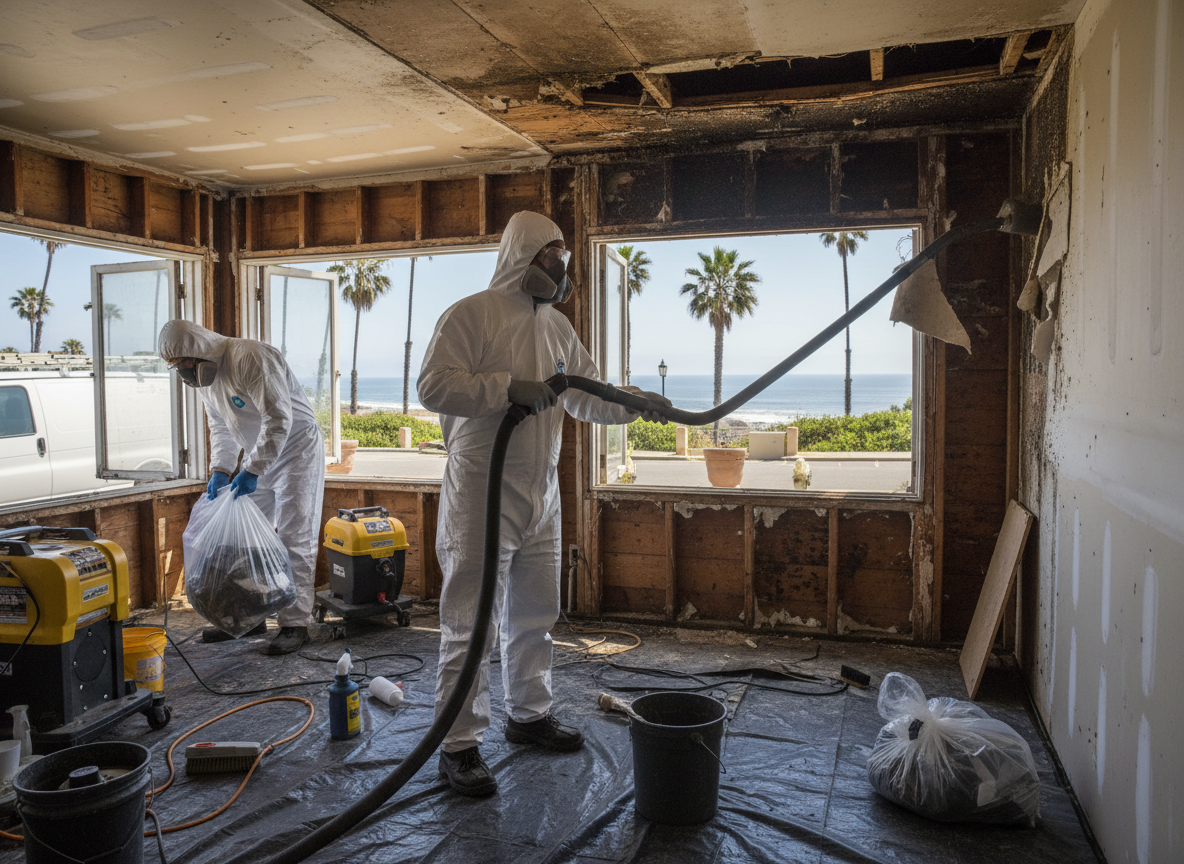
Del Mar's older wood-frame homes in Del Mar Village and Del Mar Heights often trap moisture behind stucco or plaster due to the constant salt-laden fog that rolls in from the Pacific. This creates hidden growth along sill plates and in crawl spaces where poor original ventilation meets the area's sandy soil that holds water after winter rains. Technicians must cut back affected drywall carefully to avoid disturbing settled spores that could travel through the open floor plans common in these properties near Powerhouse Park.
The mild year-round temperatures in San Diego County mean mold never fully goes dormant the way it does inland, so remediation in North Beach cottages frequently involves addressing both visible colonies and the thin film of growth on subflooring that only shows up under moisture meters. Crews working near Del Mar Racetrack also watch for HVAC systems pulling in ocean air that carries additional humidity straight into attics, requiring negative-air machines and sealed containment that accounts for the lightweight construction of many 1960s and 1970s builds.
Homeowners in Solana Beach and Encinitas sometimes discover the same pattern when coastal breezes push damp air through single-pane windows and into wall cavities. Proper removal includes HEPA vacuuming every surface after antimicrobial treatment and then running dehumidifiers until readings stay below 50 percent, because the local climate makes quick rebound common if any residual moisture remains in the plaster or insulation.
Technician insight
In Del Mar the thing that catches most people out with mold remediation company is how the constant salt fog keeps crawl spaces and attics damp even in summer, so a small leak in a Del Mar Heights roof can turn into wall-to-wall growth behind the plaster before anyone notices.
Hidden Growth After Window Leak
A North Beach homeowner noticed a musty smell near the living room after heavy coastal fog. Inspection found water had entered around a single-pane window and wicked into the drywall and insulation. We contained the room, removed the wet sections, treated the framing, and ran dehumidifiers until readings stabilized. Clearance testing passed and the family moved back in without further odor.
How it works
- 1
Inspection and Moisture Mapping
Technicians arrive with moisture meters and thermal cameras to locate hidden water behind walls and under floors in Del Mar homes.
- 2
Containment Setup
Plastic barriers and negative air machines isolate the work zone so spores do not spread through the open layouts typical of North Beach properties.
- 3
Removal and Cleaning
Affected materials are removed, surfaces are HEPA-vacuumed and treated, then the area is dried with dehumidifiers suited to the coastal humidity.
- 4
Final Clearance Testing
Air and surface samples confirm levels are back to normal before barriers come down and the space is returned to use.
Pricing
Cost depends on square footage affected, depth of hidden growth, and access in older Del Mar construction.