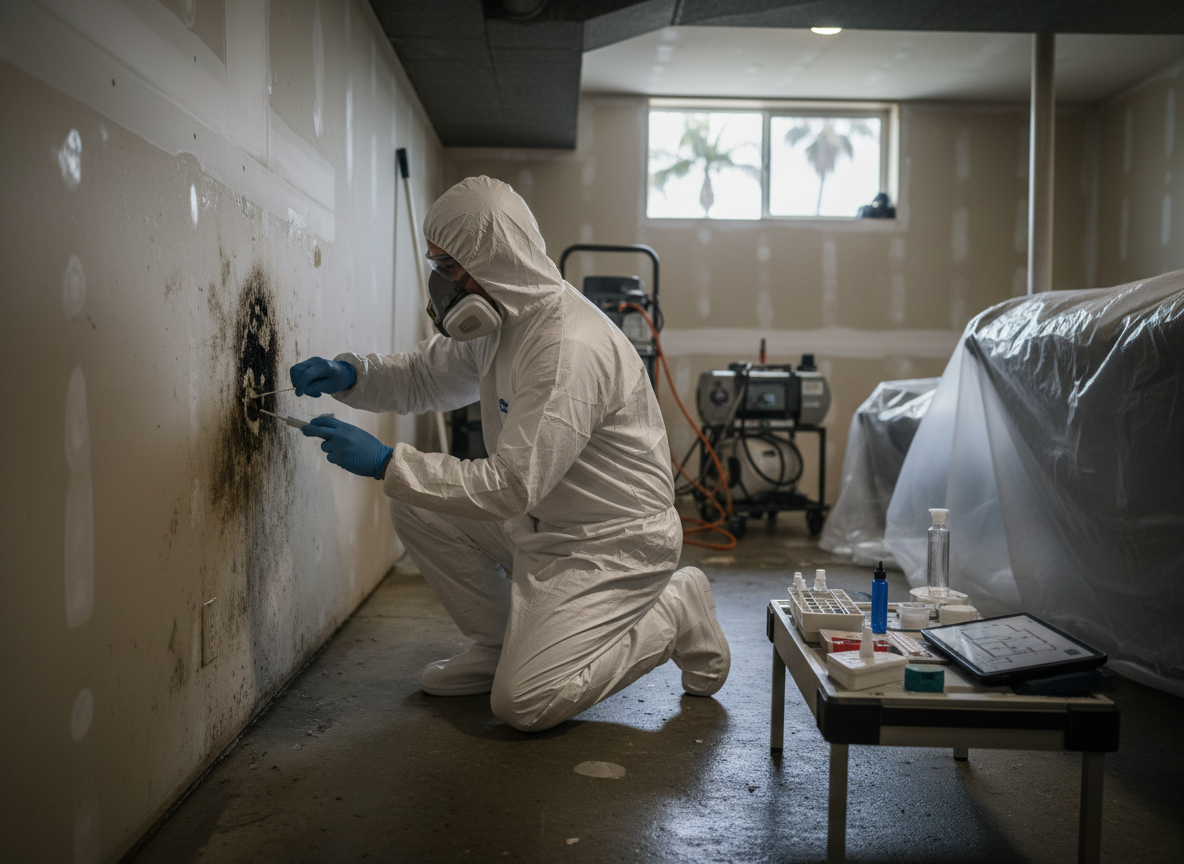
Del Mar's mild Mediterranean climate keeps humidity levels elevated year-round, especially in homes close to Del Mar Beach and Powerhouse Park where ocean air infiltrates older wood-framed structures common in Del Mar Village. Emergency mold testing must account for salt-laden moisture that promotes hidden growth behind stucco and in crawl spaces, conditions less common inland but routine here. Technicians check HVAC returns and attic insulation first because coastal fog and occasional winter rains drive condensation in these assemblies.
Properties in Del Mar Heights often sit on slight rises with variable drainage, so testing protocols include moisture mapping of slab edges and window wells that collect runoff from the surrounding hills. Air sampling and surface swabs are collected under negative pressure to avoid cross-contamination between rooms, then sent to an independent lab for speciation. Reports note whether species like Stachybotrys or Aspergillus are present, information critical for San Diego County health-department notifications when tenants are involved.
Testing near the Del Mar Racetrack and along Camino Del Mar frequently reveals mold in guest cottages and detached garages where roof leaks go unnoticed until heavy coastal winds drive water under tiles. Emergency calls require same-day arrival because spore counts can spike quickly once a leak activates. Results include chain-of-custody documentation and recommendations for targeted remediation rather than whole-house treatment when the source is isolated.
Technician insight
In Del Mar, the thing that catches most people out with emergency mold testing services is salt air corrosion on older galvanized ductwork in homes built before 1980 near North Beach. Homeowners often assume visible ceiling stains are the only issue, yet the real growth hides inside the ducts where coastal humidity never fully dries out.
Hidden Growth Behind Tile in Del Mar Village
A homeowner in Del Mar Village noticed musty odors after winter rains but found no visible mold. Testing revealed elevated spores in the master bath wall cavity where a cracked shower pan had leaked for months. Samples confirmed Aspergillus behind the tile; the report guided targeted removal without disturbing the rest of the 1950s cottage.
How it works
- 1
Initial Intake
Gather property details, symptoms reported by occupants, and access instructions while dispatching a technician from the 1409 Camino Del Mar location.
- 2
On-Site Visual and Moisture Assessment
Inspect high-risk zones including attics, crawl spaces, and HVAC systems using moisture meters and thermal imaging.
- 3
Sample Collection
Perform air, surface, and bulk sampling under controlled conditions, then label and secure samples for lab transport.
- 4
Analysis and Reporting
Receive lab results within 24-48 hours and deliver a written report with findings, photos, and next-step guidance.
Pricing
Cost depends on square footage, number of samples, and whether after-hours access is required; quotes provided before work begins.